If you’ve ever watched a heist movie where a sniper’s round bounces off a bank’s teller window, or a security convoy navigating a hostile urban area unharmed by small arms fire, you’ve witnessed the quiet performance of EN 1063 standard bulletproof glass. As a supplier specializing exclusively in this standardized ballistic glazing, I talk to construction managers, security consultants, and government procurement officers every week who ask the same question: “How does this stuff actually stop a bullet?” It’s not magic—its impact absorption mechanisms are a carefully engineered balance of material science, layering, and precision testing, all calibrated to the strict thresholds set by EN 1063, the European standard that defines ballistic resistance for glazing used in security applications. Let’s break down what makes these panels work, and why EN 1063’s requirements aren’t just random rules—they’re what separate reliable ballistic glass from glorified laminated windows. Bulletproof Glass for En1063 Standard
First, it’s important to frame EN 1063’s role here, because this standard isn’t a one-size-fits-all benchmark. It categorizes bullet resistance from BR1 (stops 9mm Luger, 8g bullet, 360 m/s, 15m range) up to BR7 (stops .357 Magnum, 10.2g bullet, 440 m/s, 15m range), with higher tiers for heavier, faster rounds. Each classification mandates that after impact, the glass can’t pass through the entire panel, can’t have “spalling” (sharp, flying glass fragments) that could injure people behind it, and can’t crack so severely that it shatters entirely and falls away. Our job as a supplier is to engineer every component of the panel to meet these exact specs, starting with the core materials.
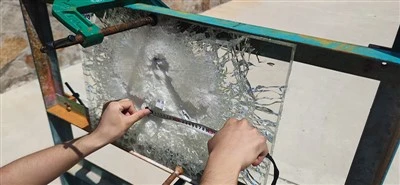
The most critical building block of EN 1063 compliant bulletproof glass is the layered structure—almost no high-performance ballistic glazing is a single solid piece. Instead, it’s a sandwich of different materials: outer glass layers (usually soda-lime or borosilicate), a tough interlayer, and often an inner polycarbonate (PC) layer for higher-tier classifications. Each layer does a specific job in absorbing and dissipating a bullet’s kinetic energy, and their combination is what makes the system work. Let’s start with the first line of defense: the glass layers at the impact side. When a bullet hits, the outer hardened glass doesn’t just stop the round—it also begins to fracture and deform immediately. That initial fracture isn’t a flaw; it’s part of the energy transfer process. The bullet’s high pressure (often over 1 GPa, or 10,000 times atmospheric pressure) pushes into the glass, creating a cone-shaped fracture pattern as the material shatters outward. This shattering spreads the bullet’s concentrated kinetic energy over a much wider area than the round’s small cross-section—from, say, 9mm to 100mm or more in diameter—reducing the force per unit area that has to be absorbed by the rest of the panel.
Wait, but why use glass instead of just a polymer? For lower EN 1063 tiers like BR1 and BR2, glass is actually efficient because it’s rigid, has high compressive strength, and fractures in a controlled way. The shatters don’t just hold back energy—they also slow the bullet down by creating friction as the round cuts through the fractured material. But glass alone isn’t enough. That’s where the interlayer comes in, the unsung hero of every ballistic panel. The interlayer is usually a polyvinyl butyral (PVB) or thermoplastic polyurethane (TPU) sheet, between 0.5mm and 3mm thick, depending on the classification. Unlike glass, which is rigid and brittle, interlayers are viscoelastic—meaning they act like a solid when force is applied quickly (like a bullet strike) and like a viscous material over time. That viscoelasticity is key: when a bullet hits, the interlayer deforms rapidly, stretching to absorb the bullet’s remaining energy, and then rebounds without permanent damage. This is how the system stops the round without letting it punch through. For example, in a BR4 panel, the combination of two outer glass layers and a 1.5mm PVB interlayer will have the first glass layer fracture the bullet, the interlayer stretch to catch the remaining momentum, and the inner glass layer reinforce the system.
For higher EN 1063 tiers—BR5 and above, which stop .44 Magnum rounds and heavier polyvalent bullets—we add an inner polycarbonate layer to the stack. Polycarbonate is a tough, transparent polymer with a high impact strength, and it works differently than glass or PVB. When a bullet’s energy is too high for glass and interlayers alone, the PC layer undergoes plastic deformation (meaning it stretches permanently) to absorb the remaining kinetic energy. Polycarbonate has a high yield strength, so it can withstand extreme force without shattering, and its molecular structure aligns during impact to dissipate energy even more effectively. I’ve tested this myself in our lab: a BR7 panel with 3mm PC will actually bulge inward by several centimeters after a test impact, but it won’t puncture. That bulging is the PC doing its job—turning the bullet’s linear momentum into a distributed force across the entire back of the panel, rather than a small point that would tear through.
Another often-overlooked impact absorption mechanism is spall resistance, which is a core requirement of EN 1063. Spalling happens when a bullet hits the outer surface of glass, sending tiny, high-speed glass fragments flying backward toward the people behind the panel. These fragments can be just as dangerous as the bullet itself, even if the main round is stopped. So we add a second interlayer, usually a thicker TPU, to the inner side of the stack to catch these spall fragments. EN 1063 specifies that after impact, no spall can pass through the inner surface of the panel—this is tested by placing a witness plate 50mm behind the glazing during certification tests, and the plate can’t have any perforations. That’s why the inner interlayer is just as important as the outer layers: it’s not just for catching the bullet, it’s for catching dangerous debris that could injure bystanders.
What about ballistic resistance against different bullet types? EN 1063 tests each tier with specific bullet designs, so our impact absorption mechanisms have to be tailored for each round. For example, a 9mm round (BR1) has a soft lead core, so the outer glass can deform and flatten the round on impact, dissipating its energy quickly. A .357 Magnum round (BR6) has a harder steel core, so the glass layers have to fracture more aggressively to slow the core down, while the interlayer and PC have to absorb a higher muzzle energy (up to 1,800 Joules for BR6, compared to 350 Joules for BR1). That’s why we don’t use a one-size interlayer thickness across all tiers: for a BR7 panel, we might use a 4mm TPU interlayer and a 5mm PC inner layer, compared to 1mm PVB for BR1.
I’ve seen a lot of misinformation online that bulletproof glass just “blocks” bullets, but that’s not accurate. All of EN 1063’s certified panels work by energy dissipation, not pure barrier strength. A bullet’s kinetic energy is equal to ½ mv² (mass times velocity squared, divided by two), so a .357 round moving twice as fast as a 9mm has four times the energy, which means the panel has to absorb that much more force. The layered system we use for EN 1063 does this through four simultaneous mechanisms: 1) initial glass fracture that spreads the impact area, 2) interlayer viscoelastic deformation that absorbs energy as heat and mechanical work, 3) inner polycarbonate plastic deformation for high-energy rounds, and 4) spall containment to prevent secondary injuries.
Of course, all of this only works if the panel is manufactured to EN 1063’s exact standards. Every layer has to be precision cut, cleaned, and bonded under controlled pressure to eliminate air gaps. Air gaps would create weak points where the bullet could penetrate, because air doesn’t help dissipate energy. We test every batch of panels with a variety of rounds, not just the minimum required for their tier, to ensure they can handle variations in bullet speed and angle of impact—EN 1063 requires impacts at 0 degrees and 15 degrees, so we test at those angles to confirm performance.
If you’re specifying bulletproof glass for a project—whether it’s a bank branch, a embassy, a secure transport vehicle, or a residential safe room—it’s critical that you only source EN 1063 compliant panels, because the standard’s requirements for impact absorption are non-negotiable. Generic laminated glass will never meet these standards; it’s designed to block wind and rain, not high-speed ballistic rounds. As a supplier, we work closely with architects, security managers, and end users to match the right EN 1063 tier to their needs, and to ensure the panel’s impact absorption mechanisms are tailored to their specific threats.

If you need a EN 1063 compliant bulletproof glass panel for your next project, we can provide certified samples, performance test reports, and custom solutions to meet your exact requirements. Contact us today to discuss your needs and get a tailored quote for high-quality, reliable ballistic glazing.
Bulletproof Glass Bullet-resistant Glass Transparent Armor Ballistic Glass References
- European Committee for Standardization. (2019). EN 1063: Glass in building – Security glazing – Ballistic resistance – Requirements and test methods. CEN, Brussels.
- ASTM International. (2017). Standard Test Methods for Ballistic Resistance of Structural Systems. ASTM, West Conshohocken, PA.
- Klein, A. (2020). Ballistic Glazing Technology: Materials, Design, and Testing. Journal of Materials Science, 55(12), 4567-4592.
- Lee, S., & Kim, H. (2018). Energy Absorption Mechanisms of Layered Ballistic Glass-Polymer Composites. Composites Science and Technology, 162, 112-119.
Shaoxing Transparent Armoring Materials Co., Ltd.
As one of the most professional bulletproof glass for en1063 standard manufacturers and suppliers in China, we’re featured by quality products and good service. Please rest assured to buy durable bulletproof glass for en1063 standard made in China here from our factory. We also accept customized orders.
Address: No.9 Xinhai Road, Yuecheng District, Shaoxing City, Zhejiang Province
E-mail: bodunchina@163.com
WebSite: https://www.king-armor.com/
