Hey everyone, let’s cut to the chase — if you’re in toolmaking, mold making, or any part of precision manufacturing, you’ve probably run into this problem: you need a hole that’s not a perfect circle. Like, say, an elliptical hole for a hydraulic fitting, a D-shaped hole for a drive shaft keyway, or a weirdly contoured profile for a aerospace component. Drilling these with a regular old drill press? You’ll get wobbly edges, burrs, inconsistent walls, and probably have to do so much secondary machining that it makes the whole project not worth the hassle. That’s where Drill EDM comes in — and as a Drill EDM supplier, I’ve spent years walking shops through exactly how to pull off non-circular holes with this tech, no fancy overcomplications required. Drill EDM

First, let’s make sure we’re on the same page: Drill EDM isn’t your granddad’s spark-eroder for big parts. It’s the workhorse for small, deep, precise holes (even tiny ones, like 0.1mm diameter, that you could never drill with a mechanical drill) — and the reason it crushes non-circular holes is because it doesn’t touch the part with a physical drill bit. We’re talking electrical discharge here: a copper or graphite electrode shoots tiny sparks, melts and vaporizes material, and the whole thing runs in a dielectric fluid (usually deionized water or oil) that flushes the debris out. No cutting force, no bit flex, no tool wear messing up your geometry — that’s the game-changer.
Now, before we get into the actual drilling steps, let’s bust the biggest myth I hear all the time: “Non-circular holes with Drill EDM? That’s only for the super fancy, high-end models.” Nah, our entry-level Drill EDM rigs can pull this off, as long as you’re set up right. The key part here isn’t the machine itself — it’s the electrode and the programming. Let’s break it down like I’m explaining it to a new machinist who just started on our gear, no jargon overload.
First up: pick your electrode. For most non-circular holes, you’re gonna use a shaped copper electrode (graphite works too, but it’s a bit more brittle for complex shapes). If you need a D-shaped hole, you don’t have to mill a weird bit — you can take a standard round electrode and machine one flat edge on the end. For elliptical or custom profiles, you can 3D print a copper electrode (yes, 3D printed EDM electrodes are a thing now, way faster than milling for one-off parts) or have your tool shop machine a custom solid electrode. Pro tip from my team: if you’re doing a shallow non-circular hole, a slightly oversize electrode works, so you don’t have to fuss with super tight tolerances on the electrode shape. For deep holes (like 10x the diameter), go with a precision-machined electrode — 0.002” tolerance max, or you’ll end up with lopsided walls.
Next, the machine setup. This is where most shops mess up, even if they’ve used Drill EDM for round holes. First, dielectric fluid level: you can’t have sloshing here. Keep it 1-2 inches above the part surface, and make sure the flush jets (the ones that shoot fluid around the electrode) are aligned to hit the gap between the electrode and the work. For non-circular holes, you might need to adjust the flush pressure — too high, and it’ll tug the electrode off path; too low, and debris clogs the gap, causing sparks to bounce and mess up your shape. We usually set flush pressure between 0.5 and 1 bar for thin electrodes, up to 1.5 bar for thicker custom ones — and our machines have a quick flush pressure dial, no coding required, so you don’t have to call a tech every time.
Then, the programming. This is the actual “drilling” part that makes the non-circular shape. Round holes use G-code with a linear feed, right? For non-circular, we use what’s called “contour helical interpolation” — that’s a fancy way of saying the machine’s Z-axis (the drill axis) moves down, while the X and Y axes move in the shape you want. So if you need an ellipse, you program the X and Y to trace an ellipse as you feed the Z down. The cool thing about modern Drill EDM controllers is you don’t need a degree in CNC to do this. Most of our systems let you upload a DXF of your non-circular hole shape, and the controller converts it to G-code automatically. No typing lines and lines of code — just upload, tweak, and go.
Wait, but what about deep holes? If you’re drilling a 50mm deep D-shaped hole, not just a 5mm shallow one, you have to handle the flushing differently. Debris is the enemy here — if it gets stuck, you’ll get a “short circuit” (the electrode touches the part) which ruins your shape. So we program what’s called “peck drilling” for EDM, too: every 0.5mm or so, the electrode pulls up 1mm for half a second, then feeds back down. This flushes the debris out, so it doesn’t build up in the hole. For non-circular holes, make sure your peck depth matches the contour — if the hole has tight curves, go a little shallower on pecks to catch debris before it gets stuck in the nooks.
Now, let’s talk about common mistakes I see shops make, because even with the right machine and electrode, it’s easy to mess this up. First: not accounting for the “overcut”. EDM doesn’t just remove material exactly where the electrode is — the sparks spread a tiny bit, so the hole will be a little larger than the electrode shape. That overcut is usually between 0.005” and 0.020” depending on your current settings. For critical parts, you can test this on a scrap piece first — run a small non-circular hole, measure it, then adjust your electrode size or the G-code to compensate. Second: using too high amperage. More current means faster material removal, but it also means bigger sparks, bigger overcut, and rougher walls. For non-circular holes, lower amperage (2-10 amps, depending on material) is better — it gives you tighter shape control, no ragged edges, and less secondary polishing. Third: not checking the electrode for alignment. A tiny tilt in the electrode will make one side of the non-circular hole thinner than the other, especially for deep holes. Our Drill EDM machines have an auto-alignment tool that lets you check electrode position in 2 minutes, no dial indicators needed — but even if you have an older machine, a quick visual check under a magnifier will catch most tilts.
Let’s run through a real example, something a shop actually brought to us last month. They made hydraulic valves, and needed 8mm deep D-shaped holes (keyways for the valve spool) that had to be within 0.003” of flat across the D-face. They tried using a CNC mill with a custom end mill, but every batch had 10-15% scrapped parts from burrs and wobbly edges. They switched to our Drill EDM model, and here’s what we did: we took a 3mm diameter copper round electrode, machined a flat edge on the end to make a D-shape, programmed a simple contour helical interpolation G-code from their DXF, set flush pressure to 0.7 bar, amperage to 5 amps, and peck depth of 0.4mm. The first test hole was spot-on — no scrap parts, and their cycle time was 20% faster than the mill process. That’s the kind of win Drill EDM brings for non-circular holes.
Another question I get all the time: can you do internal threads that are non-circular? Like, a splined hole for a gear hub? Yep, same logic. You just use a shaped electrode (a splined copper electrode) and program the helical interpolation to trace the spline as you feed down. No tap, no thread chasing, no broken tools — which is huge for shops that deal with hard materials like titanium or Inconel, where mechanical threading is a nightmare.
Now, if you’re still on the fence about switching to Drill EDM for these holes, let’s talk about materials. It works on pretty much anything conductive: steel, aluminum, copper, titanium, even carbide. I’ve had shops use it for non-circular holes in surgical tools (D-shaped holes for pin placement) and automotive fuel injectors (odd-shaped holes for fuel flow) — no material is too hard, no geometry is too weird, as long as it’s conductive.
Wait, let’s address the “but what about cost?” elephant in the room. A lot of shops think Drill EDM is more expensive than mechanical drilling, but when you factor in scrap rates, secondary machining (polishing, deburring, reworking), and tool wear (mechanical drill bits for custom shapes wear out super fast), it’s actually cheaper. Our Drill EDM machines have low operating costs — the electrodes last 10x longer than custom end mills, and the electricity and dielectric fluid costs are minimal per part.
Now, if you’re ready to stop fighting with wobbly non-circular holes and start cutting parts that are perfect on the first try — let’s talk. I work with shops of all sizes, from small toolrooms with 2 machinists to large aerospace manufacturers, and we have models that fit every budget and production volume. We can even help with custom electrode design, G-code setup, and on-site training so you don’t have to figure this out alone.
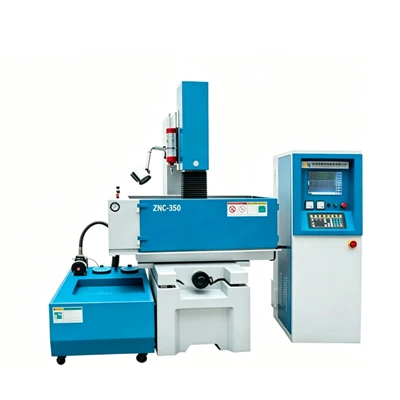
ZNC Die Sinker EDM At the end of the day, Drill EDM isn’t just for round holes anymore. Non-circular holes don’t have to be a headache — with the right electrode, simple programming, and a solid Drill EDM setup, you can nail that elliptical, D-shaped, or custom-profile hole without all the extra work. No burrs, no scrap, no wasted time. If you’re tired of missing tolerances on non-circular holes, reach out to us to chat through your specific project. We’ll help you figure out the easiest, most cost-effective way to get the holes you need.
References
- EDM Handbook Technical Guide. Makino Manufacturing Co., Ltd., 2021.
- Modern Drilling and Machining Processes. Society of Manufacturing Engineers, 2020.
- Practical Guide to Non-Circular EDM Hole Machining. Technical Association of the Electrical Discharge Machining Industry, 2022.
Taizhou Ouling CNC Equipment Co., Ltd.
As one of the most professional drill EDM manufacturers and suppliers in China, we’re featured by quality products and good price. Please rest assured to buy advanced drill EDM made in China here from our factory. Welcome to contact us for quotation.
Address: No. 9 jingang Road, Yangzhou City Jiangsu Province, China
E-mail: 574751243@qq.com
WebSite: https://www.oulingedm.com/
